
Beaver Parole and Probation
Utah assigns the release decision and day-to-day supervision to different bodies. The Utah Board of Pardons and Parole decides whether a state prisoner is paroled, when a sentence terminates, and how a claimed violation is resolved. The Utah Department of Corrections Division of Adult Probation and Parole, known as AP&P, supervises both parolees and probationers. A Beaver County jail record may show the custody event that happened first, but it does not replace either agency's supervision record.
Parole follows release from state prison while the sentence continues. Probation is community supervision ordered by a court. A person can receive probation after county jail time, after a suspended prison term, or without a state-prison stay. For that reason, a UDC result marked “Probationer” does not prove release from prison. The judgment and Beaver County Correctional Facility movement record are needed to reconstruct what happened before supervision began.
| Point | Parole | Probation |
|---|---|---|
| Who orders it | Utah Board of Pardons and Parole | District court under the judgment |
| What it follows | Release from a state-prison sentence | A court sentence, which may or may not include custody |
| Who supervises | UDC Adult Probation and Parole | UDC Adult Probation and Parole |
| Best public records | UDC legal status plus Board decision | UDC legal status plus court judgment |
| How it ends | Board termination or maximum-sentence expiration | Court termination or completion shown in the case |
- Parole
- Release from prison to community supervision while the state sentence remains active.
- Probation
- A court-ordered community status that does not, by itself, show prior prison release.
- Discharge
- The end of the sentence or supervision, not merely the day a person leaves a facility.
- Absconder
- A supervised person alleged to have stopped reporting or left supervision without permission.
Check Beaver Post-Release Supervision
Begin with the UDC Offender Search. It covers people currently under UDC supervision, including inmates, parolees, and probationers. Search by UDC number when known. A name search needs at least one character in both first and last name. Compare the offender number, birth date, sentencing case, and other identifiers before treating the result as the correct person.
The legal-status field is the key. “Parolee” supports release from prison into supervision. “Inmate” means state custody continues, even if the listed placement is a contract county jail. “Probationer” confirms supervision but not a prison-release event. No result remains inconclusive because a fully discharged person can disappear from the current-supervision-only search.
- Search UDC and match more than the name.
- Read legal status before reading the listed placement.
- Search the Board hearings and decisions portal by name, offender number, or date range.
- For probation, inspect the Utah court judgment and later case history.
- Contact Region 5 for locally releasable supervision information.
- If the person has fully discharged, request the legal-status and termination record from UDC.
The Board record can show parole, rehearing, termination, rescission, or another review outcome. A future Board date alone does not prove that physical release took place. UDC status, VINE, or a custody-movement record shows whether the ordered event was carried out. The Beaver County released-inmate search explains the county movement-record path when the starting point was BCCF.
Note: A Board order explains legal authority, while the custodian's movement record confirms the actual change in physical custody.
Beaver Supervision Uses Region Five
No AP&P office is listed in Beaver city. UDC assigns Beaver, Garfield, and Iron Counties to the Region 5 Cedar City office. That regional arrangement matters when the online record shows current supervision but does not identify a public agent lookup. The office can address information it is legally allowed to disclose, while the Board remains the source for a parole decision and the court remains the source for probation orders.
UDC Adult Probation and Parole, Region 5181 East DL Sargent Drive, Suite B-101
Cedar City, UT 84721
435-586-5350
AP&P division: 801-545-5908
The official UDC probation and parole page identifies the regional office and explains the division's supervisory role. The source screen below shows the regional office context used for Beaver County post-release supervision.
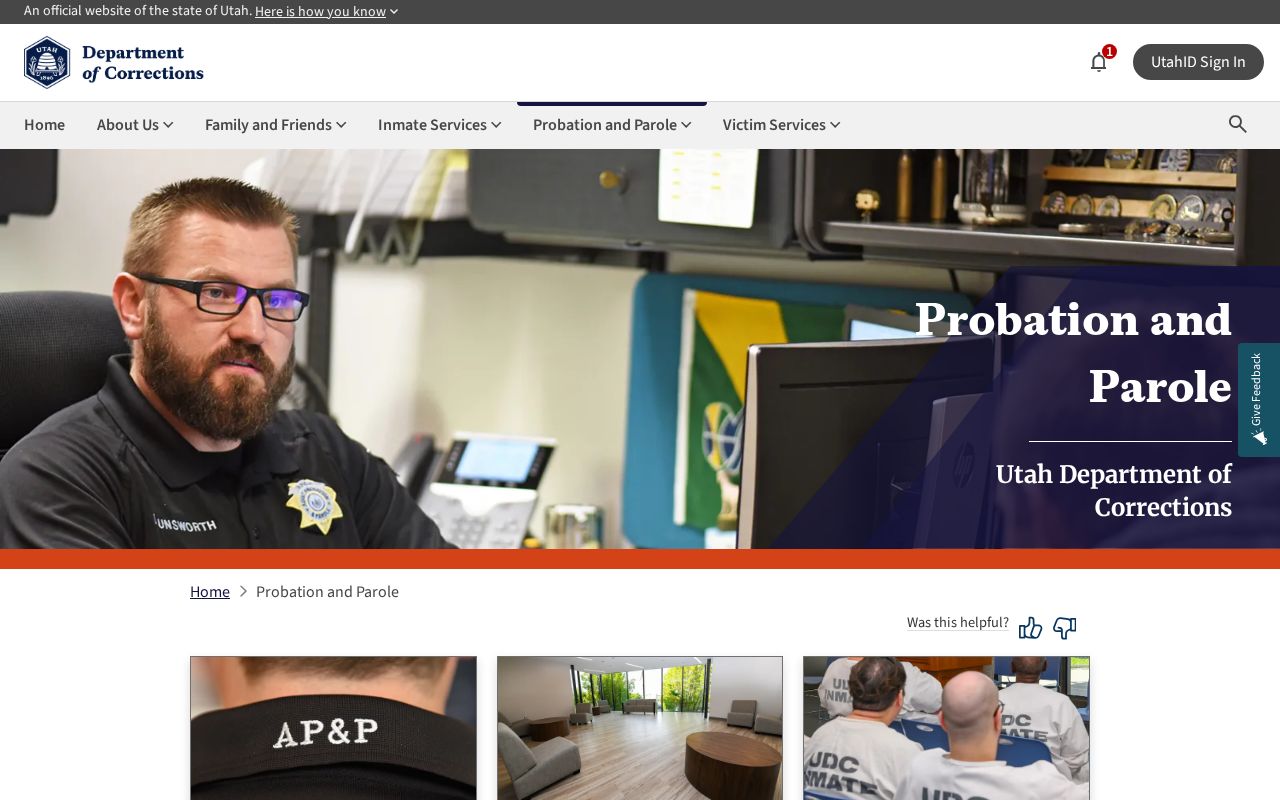
Use the office as a local verification route, not as a substitute for the public Board decision or court case.
Beaver Parole Decision Records
The Board's combined portal supplies both hearing-calendar and decision searches. First and last name are required for a name search, and known aliases are also checked. An offender number or date range offers another path. Results may require browser pop-ups. The terms in a result must be read as written because an original hearing, paper review, redetermination, violation hearing, and rescission do not mean the same thing.
The combined calendar and decision search is the official starting point for those records.
A matched decision can explain the legal milestone, but current UDC status still confirms whether post-release supervision is active.
Under Utah Code § 76-3-202, a person paroled after the end of 2018 generally stays on parole through the maximum-sentence expiration unless the Board ends parole sooner under its rules. Thus, release from confinement and termination of the sentence are different dates. A durable record should identify both when each matters.
Beaver Supervision Warrants and Discharge
AP&P describes agents seeking warrants when a person absconds and fugitive teams trying to locate that person. An absconder label, violation claim, or parole warrant does not mean supervision ended. It means the case remains active and may return to the Board or court. Avoid treating a warrant as proof of guilt or as a final violation finding.
Utah Board procedures allow several outcomes. An allegation may be dismissed. A warrant can be recalled and parole reinstated. The Board may send the matter to an evidentiary hearing, or a violation can lead to a return to custody. Because those outcomes differ sharply, verify the current order and UDC status instead of relying on an old notice.
Discharge requires a later record. For parole, look for Board termination or maximum-sentence expiration and request UDC legal-status history when the person no longer appears online. For probation, read the court case for termination or completion. Neither an inactive web result nor a missed VINE match proves discharge.
Note: “Absconder” describes an alleged supervision breach, while “discharged” means the sentence or supervision has legally ended.
Beaver Supervision Status Alerts
VINE adds a timely notice layer, but it is not the long-term supervision record. Beaver County's service can report a jail custody change, while UDC VINE covers state-prison events. State events include release, a parole date notice, return from escape, death, moves between prisons, placement in a county jail, and movement to a community correctional center. A move to a structured community placement is not the same as unconditional discharge.
Registration is free and can use telephone, email, or text when available. Select the matched person and compare identifiers. For telephone notice, choose a four-digit PIN and enter it when the automated call arrives. UDC says calls may repeat hourly for up to forty-eight hours until the correct PIN confirms receipt. Even an urgent alert should be checked with UDC, the Board, or the county custodian.
The official Beaver County VINE page confirms anonymous custody checks and local notification options. It also routes readers to Victim Advocate Services at the Beaver County Public Safety Facility. VINE does not promise a permanent history, so an older supervision or discharge question belongs with UDC records, the Board decision, and the court case.
Property After Beaver County Release
Beaver County publishes a narrow property procedure that can be used through mail or during visiting. It requires a property transaction or release form. The county does not publish a final-release property desk, a deadline for pickup, an after-hours method, an exit door, or a family waiting area. Those gaps matter because visiting rules should not be assumed to control the release-day handoff.
The official Beaver County property instructions establish the form process. For the actual handoff, call Corrections at 435-438-6497 and ask what applies to that person and release event. A state prisoner processed through Utah State Correctional Facility follows UDC procedures instead of the ordinary Beaver jail process.
This distinction also protects against a common error. Property release can occur while someone remains confined. It is not evidence that custody or supervision ended.
Beaver Electronic Monitoring Status
Beaver County documents an electronic-monitoring program for pretrial defendants, sentenced probationers, and adult parolees. Monitoring is therefore a local status between secure detention and unconditional discharge. A monitored person may be physically in the community while remaining bound by a court order, probation terms, or parole conditions.
The county offers an intake and appointment route on its electronic monitoring page, but no public participant search was found. Verify monitoring through the relevant court case, UDC supervision record, or information the supervising office can disclose. Do not infer it from a booking card or from the person's absence from the jail.
For a pretrial defendant, the court docket supplies the release and monitoring order. For a probationer, use the judgment and AP&P status. For a parolee, pair the Board order with UDC legal status. Each route identifies the authority that created the monitored placement.