
Beaver Three-Day Release Window
No official Beaver County page was verified that filters jail releases to the prior 72 hours. The sheriff's Recent Bookings page advertises admissions from the past 30 days. It does not provide a release timestamp, release reason, released-only marker, or three-day filter. Its public cards can support a search, but they cannot be turned into a release list by counting backward from the present.
A 72-hour inquiry differs from a same-day check in scope. It may cover events from several court sessions, overnight processing periods, or a weekend. The wider span can help a reader build a list of cases to verify. It does not cure the booking page's core limitation. Each person still needs an affirmative custody-change source.
Verify Beaver 72-Hour Releases
Work from each person, not from a guessed released roster. The key question is whether Beaver County recorded a community release, a transfer, or another custody event within the chosen three-day range. Strong identifiers reduce false matches when several people share a name.
- Set the exact start and end of the 72-hour period. Keep the local time zone consistent while comparing records.
- Search the official booking display for admissions tied to the period or to a known earlier arrest. Save the booking number, arresting agency, charge, and court.
- Check VINELink under Utah for each person. Compare identifiers and read the agency plus custody status.
- Review the Utah court case for bond, dismissal, sentence, or other orders that may explain a change during the period.
- Call Beaver Corrections at 435-438-6497 and ask for the date, time, and type of the latest movement, including the receiving agency when transferred.
- Use the Beaver GRAMA form when a durable release or movement record is needed.
The booking page supplies an admission trail. VINE supplies a participating agency's status signal. The court record explains legal authority, while Corrections holds the local movement entry. Agreement among those sources is more reliable than any one negative search result.
Note: A court order can authorize release, but it does not prove when jail processing ended or whether another hold took effect.
Beaver 72-Hour Record Fields
The county's online page exposes booking facts, not a release-field inventory. Build the three-day review from the record fields that answer identity, custody, time, and event type. Ask for an existing entry tied to a person and date range.
| Field | Use in a 72-hour review |
|---|---|
| Name and booking/person number | Matches the correct person across jail, VINE, and court sources. |
| Booking date and time | Establishes the start of the local custody episode. |
| Movement date and time | Shows whether the event falls inside the selected three days. |
| Release or movement type | Distinguishes bond, time served, transfer, and other outcomes. |
| Ordering authority and case | Points to the court or agency record behind the event. |
| Receiving custodian | Shows whether custody continued outside Beaver County. |
Related fields may include bond disposition, supervision status, sentence credit, and record-correction notes. The custodian may redact protected facts. Beaver does not publish a flat fee for every request, so the form's fee acknowledgment should be followed by an estimate from Records.
The official booking display visually confirms that its scope is the past 30 days of bookings.
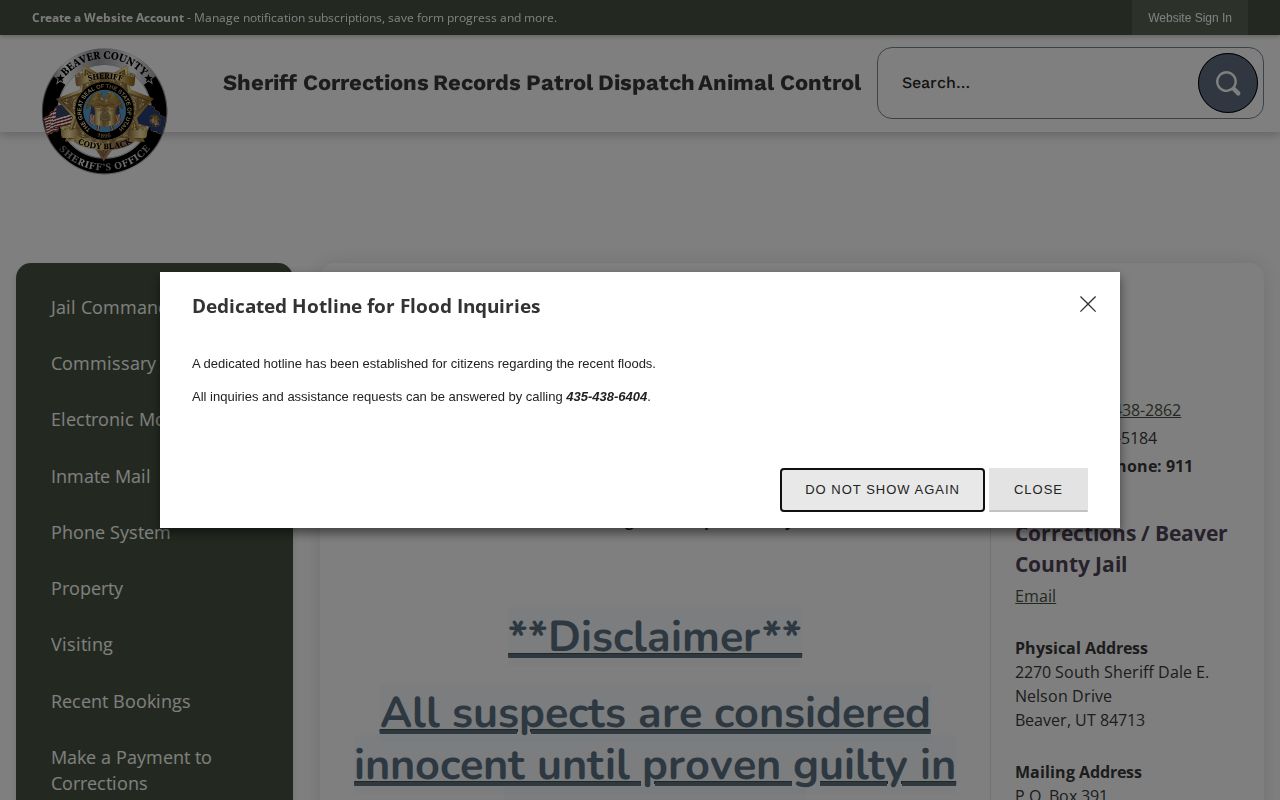
The image helps identify the correct county source. It does not add release fields that the page itself does not promise.
Beaver Weekend Release Review
A Friday-to-Monday check can cross normal records-office hours and several court-processing periods. That practical delay is a reason to preserve the exact three-day range and use VINE for status changes. It is not evidence that Beaver publishes a hidden weekend release list. The county has not promised a special holiday feed or a fixed refresh schedule.
For urgent current status, call Corrections, which provides 24-hour custody operations. Sheriff's Records has narrower service hours: Monday through Thursday from 8 a.m. to 5 p.m., and Friday from 8 a.m. to noon. Call before an in-person visit. A formal request may be handled after the weekend even when the actual custody event occurred earlier.
Court entries can also post on a timeline different from physical release. A bond order, dismissal, or sentence entry may explain why release should occur, but processing and other holds can intervene. Record both the legal event and the jail movement rather than assigning them one timestamp.
Holiday closures can affect when a records response or a new docket entry becomes available, but the research did not verify a Beaver-specific holiday release rule. Do not assume the jail holds every eligible person until the next business day, and do not assume a court order produced an instant exit. The 24-hour custody line is the best source for current confirmation, while the written movement entry preserves what actually occurred during the selected window.
A shorter same-day review uses the Beaver County 24-hour releases path. That page emphasizes immediate confirmation rather than multi-day case organization.
Beaver Booking-Display Limits
Observed dynamic cards could display a name, residence, booking or person number, arrest date and time, arresting agency, charge, crime class, statute, court, and sometimes an “IN CUSTODY” marker. That marker is a useful current-status clue when present. Its absence is not a released label.
A person may stay visible because the admission remains inside the rolling booking window even after release. Later, a card may leave the display simply because the booking aged past 30 days. Neither event supplies the affirmative movement date and type needed for a 72-hour list.
The page is dynamic, but no official source promises that it refreshes at a set hour or that every system posts at the same pace. VINELink can lag the jail record. A court docket can lag courtroom action. Phone confirmation may be limited to what staff can lawfully disclose. Those differences make a narrow GRAMA request the durable fallback.
Negative results also have different meanings. Absence from the booking page may reflect age, a name variation, or no Beaver booking. Absence from VINE may reflect coverage or data retention. Absence from UDC may mean full discharge, no state case, or a mismatch. Absence from Utah Xchange may reflect a nonpublic, sealed, expunged, older, or unmatched case. Move to another channel instead of treating any one absence as a release.
Note: Keep a record of the reporting agency because county VINE and UDC VINE describe different custody systems and release events.
Beaver Release Status Meanings
Three days of county movements can include more than community releases. Bond means a person leaves pretrial custody while the case continues. Time served or sentence expiration can end the custodial part of a sentence, though another hold may take over. Transfer means custody continues with a receiving agency. Parole means state-prison release into Board-authorized supervision, not the end of the sentence.
- Community release
- The person leaves the named custodian without a recorded transfer to another custodian.
- Transfer
- The person leaves Beaver's physical control while legal custody continues elsewhere.
- Detainer
- A request or hold from another authority that may prevent a community exit.
- Parole
- Release from prison into supervised community status while the sentence continues.
Beaver County Correctional Facility's mixed population makes these labels critical. It houses local detainees, short county sentences, people awaiting UDC transfer, and contract prisoners. A location-only search cannot establish who held legal custody at the end of the three-day period.
Death is also a custody-ending event but is not a community release. An ICE or another-agency hold can end Beaver's local custody while a new custodian takes control. Accurate three-day records preserve those distinctions rather than putting every departure into a single “released” category.
Beaver Multi-System Fallbacks
If VINE and the jail record show a transfer, continue with the receiving system. Search the Utah Department of Corrections by name or UDC number when state custody is involved. “Inmate” indicates state custody; “Parolee” supports prison release into supervision; “Probationer” does not prove a prison release. No UDC result is inconclusive because fully discharged people and unsentenced county detainees may be outside its scope.
For federal cases, the Bureau of Prisons locator can show a release date or that a person is not in BOP custody. ICE's locator covers current detention and, officially, some people released from ICE within the prior 60 days. The U.S. Marshals Service has no comparable public name locator, so the federal docket and a focused records request may be required.
For older or ambiguous county cases, use Utah Xchange and the Sheriff's retained record. The broader Beaver County released inmates lookup explains how negative results differ across the county, UDC, VINE, and court systems.